 how-to
How to Sell a Luxury Home Quickly: 7 Proven Steps
Table of Contents
- Step 1: Price a Luxury Home to Sell With Precision
- Step 2: Apply Luxury Home Staging Tips That Shorten Days on Market
- Step 3: Commission Architectural Photography and Immersive Virtual Tours
- Step 4: Build a Digital Marketing Strategy for High-Net-Worth Buyers
- Step 5: Consider Selling a Luxury Home Off Market
- Step 6: How Long Does It Take to Sell a Luxury Home?
- Step 7: Manage Showings, Offers, and Tax Implications to Close Fast
- Conclusion
- Frequently Asked Questions
Last Updated: October 22, 2026
Step 1: Price a Luxury Home to Sell With Precision
The fastest way to sell luxury home inventory is to price it right on day one. Overpricing is the single biggest reason high-end listings sit on the market, and the market punishes hesitation.
At Michael Eisenberg, we have watched this play out across Greater Los Angeles for more than 25 years. A precise list price creates competition. A hopeful one creates silence.
Reading the Comparative Market Analysis
A comparative market analysis is a review of recent sales, active listings, and expired listings near your property. It sets the range buyers will actually pay.
Look at three things:
- Closed sales from the last 90 days, adjusted for size and condition
- Active listings you are competing against right now
- Expired listings that show where the ceiling sits
Your property valuation should reflect fair market value, not aspiration. Luxury buyers and their agents run these numbers themselves.
Why Overpricing Kills Momentum
The first two weeks of a listing draw the most attention. Miss that window and you are chasing the market down.
Overpricing causes three problems:
- Market saturation sets in as the listing ages
- Buyers assume something is wrong with the property
- You lose negotiation use on every later offer
Step 2: Apply Luxury Home Staging Tips That Shorten Days on Market
Professional staging is not decoration. It is a marketing tool that helps buyers picture the lifestyle, and it shortens days on market.
Start with a staging consultation before any furniture moves. A stager will walk the property and flag what stays, what goes, and what needs repair.
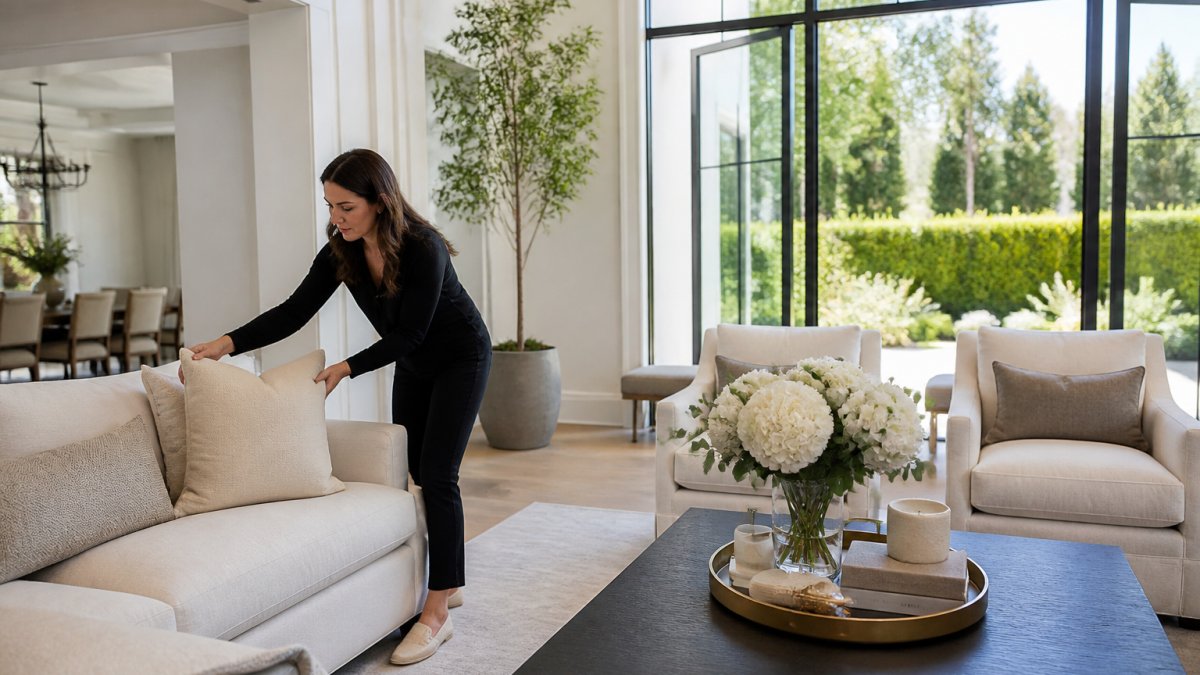
Strong luxury home staging tips we give every seller:
- Declutter to the point of near-empty; space reads as value
- Repair small flaws, because buyers read them as bigger problems
- Use neutral, high-quality pieces that photograph well
- Boost curb appeal with fresh landscaping and clean entryways
Property condition drives the final number. Staged homes photograph better, and better photos pull more showings.
Step 3: Commission Architectural Photography and Immersive Virtual Tours
Architectural photography is the first showing. Most luxury buyers see your home online before they ever drive past it.
Hire a specialist, not a general photographer. Architectural photography captures light, scale, and flow in ways phone photos cannot.
Pair stills with immersive virtual tours. A 3D walkthrough lets out-of-state and international buyers tour the property without a flight. That matters when your buyer pool spans time zones.
What to commission:
- Professional interior and exterior stills
- A 3D virtual tour with room-by-room navigation
- A short cinematic video for social and email
- Drone footage where the lot and views justify it
Virtual tours also reduce wasted private tours from buyers who were never serious.
Step 4: Build a Digital Marketing Strategy for High-Net-Worth Buyers
A digital marketing strategy for luxury homes targets a small, specific audience, not the masses. Reach and prestige matter less than reaching the right people. The difference between a luxury campaign and a standard listing campaign is precision: you are marketing to a few thousand qualified buyers worldwide, not a few hundred thousand local browsers.
Your plan should include:
- Paid social targeting by income, profession, interests, and lookalike audiences built from past luxury buyers
- Email campaigns to a vetted agent and buyer network, segmented by price band and property type
- A dedicated property website with the full media package, gated so you can capture who is viewing
- Retargeting for anyone who viewed the listing, plus sequential ads that move from teaser to full reveal
- Syndication to luxury-specific portals rather than only mass-market listing sites
Lifestyle-Based Marketing
Sell the life, not the square footage. Lifestyle-based marketing shows how the home supports how the buyer lives: entertaining, privacy, views, proximity to work and culture.
A common pattern among luxury marketers is to build the campaign around three or four lifestyle pillars drawn from the property itself, then run each pillar as its own ad set, email, and landing page section. That structure lets you test which angle pulls qualified inquiries and shift budget toward it within the first two weeks.
International Buyer Outreach
For international buyer outreach, work with agents who have cross-border networks and can present the property to buyers who may never set foot in the market before making an offer. Most practitioners find that international buyers need three things handled early: proof of funds reviewed before any private tour, discreet marketing that keeps the address and photos out of public view until the buyer is vetted, and a clear explanation of how the purchase will be titled and financed from abroad.
Practical steps that support cross-border reach:
- Translate the property website and key collateral into the languages your buyer pool actually speaks
- Schedule virtual tours across time zones rather than assuming a local showing window
- Coordinate with a tax professional early, because foreign buyers face different withholding and reporting rules than domestic buyers
- Keep a separate, private media package for buyers who require confidentiality before launch
Step 5: Consider Selling a Luxury Home Off Market
If you sell luxury home inventory off market, you show it privately to a pre-screened group before it hits public listings. For sellers who value privacy, it is often the fastest path.
The trade-off is reach. You give up broad exposure in exchange for control and discretion.
Pocket Listings and Discreet Marketing
A pocket listing is a property marketed privately through an agent's network rather than the open market. Discreet marketing keeps addresses and photos out of public view.
This works best when:
- The seller is high-profile and needs privacy
- The buyer pool is small and known
- Timing matters more than maximum exposure
Step 6: How Long Does It Take to Sell a Luxury Home?
Most luxury homes take longer to sell than entry-level homes, often several months from listing to close. The exact timeline depends on price, location, condition, and marketing reach.
Market timing matters. Seasonality, buyer demographics, and asset liquidity all shift how fast offers arrive.
A realistic timeline breaks down like this:
| Phase | Typical Duration | What Happens |
|---|---|---|
| Prep and staging | 2-4 weeks | Repairs, staging, photography, virtual tour |
| Active marketing | 4-12 weeks | Showings, private tours, offer negotiations |
| Under contract to close | 30-60 days | Inspections, appraisal, financing, title |
Speed comes from preparation and pricing, not pressure. A well-prepped, correctly priced home moves faster than a rushed one.
Step 7: Manage Showings, Offers, and Tax Implications to Close Fast
Closing fast comes down to managing three things at once: showings, offers, and the money behind the sale.
Showings and Private Tours
For showings, use curated showings and private tours that fit the seller's schedule. Pre-screened buyers and verified proof of funds cut out the spectators. A common pattern is to batch tours into a short window so the seller's household is disrupted once rather than daily, and to require lender or bank verification before a private tour is confirmed.
Offers and Contingencies
On offers, review offer contingencies carefully. Financing, appraisal, and inspection contingencies affect how fast you can close. A cash offer with a short inspection window moves faster than a financed offer with a long appraisal contingency, but the gap in net proceeds can be large enough that speed is not always the right trade. Compare offers on net proceeds and timeline together, not on headline price alone.
Tax and Legal Implications of a Rapid Sale
A rapid luxury sale can trigger capital gains and closing costs that change your net, and the timing of the sale can matter as much as the price. Talk to a tax professional before you sign, especially if the property is part of a larger real estate portfolio.
The mechanism most high-net-worth sellers ask about is the 1031 exchange, which allows a seller to defer capital gains by reinvesting proceeds into a like-kind replacement property. The rules that drive the timeline are strict:
- The seller must identify potential replacement properties in writing within 45 days of closing
- The replacement property must be acquired within 180 days of closing
- The proceeds must be held by a qualified intermediary, not received by the seller
Those deadlines run concurrently with your sale closing, so a fast sale compresses the window for lining up a replacement property. Sellers who plan to exchange should have the intermediary engaged and a shortlist of replacement properties in view before the listing goes live.
Other items to settle before signing:
- Confirm your basis and any capital improvements that reduce taxable gain
- Review state and local transfer taxes and recording fees, which vary widely by jurisdiction
- Understand whether the sale triggers any depreciation recapture if the property was rented
- Coordinate with your estate attorney if the property is held in a trust or entity
Conclusion
Selling a luxury home quickly is a challenge, but it rewards sellers who prepare, price with precision, and market to the right buyers. Michael Eisenberg brings over 25 years of Greater Los Angeles experience, a proven record with high-profile clients, and recognition as KW Beverly Hills' Number 1 Top Gun. Get started with Michael Eisenberg and move your luxury property from listing to close with confidence.
Frequently Asked Questions
How can I sell my luxury home faster?
Speed starts with accurate pricing against a current comparative market analysis, then professional staging, architectural photography, and a targeted digital marketing strategy aimed at high-net-worth buyers. Adding immersive virtual tours and pre-screened buyer outreach shortens the window between listing and offer. Sellers who combine a realistic listing price with curated private tours typically avoid the long stale-listing period that drags out luxury deals, and an experienced luxury real estate agent can sequence these steps for you.
Can I sell a luxury home without listing it publicly?
Yes. Selling a luxury home off market through a pocket listing lets you test buyer interest with discreet marketing while protecting privacy. Your agent shares the property with a pre-screened network of qualified buyers and their representatives, often requiring proof of funds before a private tour. This approach suits high-profile owners who want to avoid public exposure, though it can narrow the buyer pool, so many sellers run an off-market phase first and then move to a full listing if offers don't materialize.
How should I price a luxury home to attract buyers quickly?
Price from a fresh comparative market analysis of recent comparable sales, adjusted for property condition, high-end amenities, and current market saturation. Luxury pricing is less forgiving than entry-level pricing: a listing price above fair market value invites lowball offers and long days on market, while a well-supported price generates competition. Review buyer demographics and market timing with your agent, and revisit the listing price every few weeks so negotiation leverage stays with you.
How long does it usually take to sell a luxury home?
Luxury homes generally take longer to sell than median-priced properties because the buyer pool is smaller and purchases often involve offer contingencies, proof of funds, and detailed due diligence. Timelines vary widely with price band, property condition, and market timing. A well-priced home with strong staging, architectural photography, and targeted digital marketing typically moves faster than an overpriced one. Ask your agent for a realistic estimate based on current local data rather than a national average.